

































1 Executive Summary
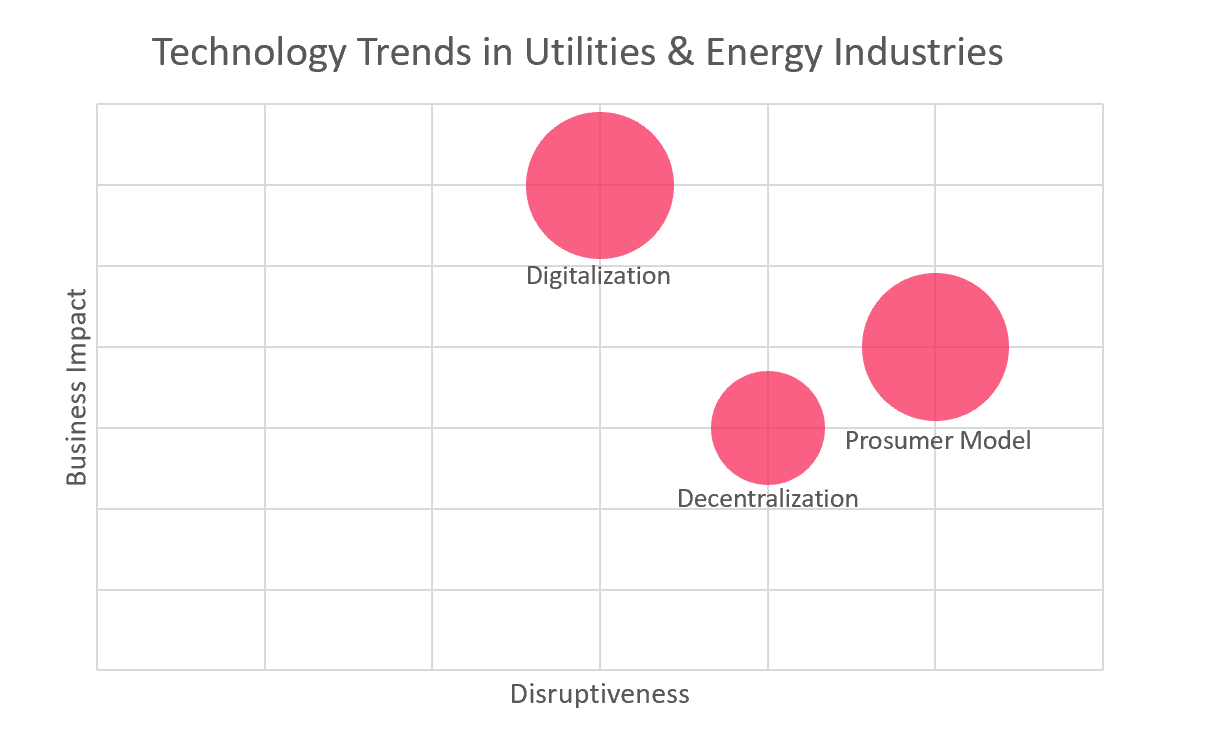
Utilities and energy companies are still relatively early on the path to digitization. Company structure for this industry has typically favored stability, particularly since there is a very low tolerance for maintenance downtime or outage. This mentality of stability is challenged by environmental pressures and public demand for alternative energy sources. Future energy systems will likely have three factors: digitalization, decentralization, and the advent of the prosumer. The combination of these trends will lead to solutions such as the smart grid which depends upon and leverages partnerships between multiple stakeholders, such as energy providers like Transmission System Operators and Distribution System Administrators, businesses, and consumers. Overhauling currently stable processes for uncertain gains is a difficult transition for the utilities sector since it contradicts this philosophy of stability.
Enter emerging technologies to this picture, and the way becomes more ambiguous. Are AI, blockchain, and IoT enough to meet changing expectations and needs from consumers in a stable, profitable way? New business models that rely on these technologies for the energy and utilities sector are gaining traction on the market. Among the top are the mobilization of the “prosumer”, provision of IoT-based efficiency services, monetizing Renewable Energy Certificates (RECs) and other global certificates, and the hypothetical entrance of utilities companies into a whole new role as identity verifiers in a Decentralized Identity scenario.
There are many potential use cases for emerging technologies in this sector, but only a few stand out as being sufficiently stable for potential adoption. AI brings opportunities for data analysis such as resource consumption analysis and predictive maintenance, while also helping with administrative tasks like document management, conversational interfaces for user behavior analytics (UBA). Industrial and consumer IoT devices provide the data to achieve these ends. Blockchain has very limited uses for this sector; billing which reflects dynamic pricing could be automated, but blockchain isn’t the sole method to achieve this. This is the same with issuing RECs, or coordinating microgrids. Blockchain has yet to prove itself the leading solution for these tasks.
The energy and utilities sector should aim to integrate emerging technologies, not because they are cutting edge or promise huge cost savings, but because they are supportive tools to achieve a more impactful end: of stimulating a digitized unification between all departments to deliver synchronized, intelligent, and efficient processes. Developing a strategy to deliver granular control of synchronized operational and administrative tasks will do more to enable energy and utilities companies to keep up with sustainability and profitability trends than simply adopting new technologies. But these technologies are some of the essential tools that would bring such a strategy to success.


